Showing posts sorted by date for query female factory. Sort by relevance Show all posts

Wednesday, 6 May 2026

Female Factory


Hi everyone it’s Wednesday morning what happened to Tuesday seems like I forgot to do a post, I was going to write about the Female Factory in Tassie but then remembered that I already had done one back in 2016 which can be found here: https://jo-annemotherandnanna.blogspot.com/search?q=female+factory

So, if you want to know about or remind yourself about the place go check it out and that’s today’s post


Friday, 1 May 2026

Cruise Day 3.....Hobart


On day three of the cruise, we were in Hobart for the day after getting off the ship we decided to get on the hop on hop off bus a tour bus and I found it interesting.


When it reached the Female Factory which was a women’s convict prison, we got of to visit the factory. After we got off the bus it was a long ass walk to the prison thankfully all downhill took us 10-15-minutes to walk there.

The tour was great I will do a post about it later, after the tour I thought we would get a cab to the next location to get back on the bus, however, Tim said it was only a couple hundred metres downhill so I agreed to walk it, he was wrong it turned out to be 1.4k’s and I felt exhausted by the time we reached the bus stop.

So, it was decided that Sue and I would return to the ship while Jess and Tim went to the old gaol, but that was closed.

As it turned out both Sue and Me as well as Tim & Jess arrived back at the ship at the same time.

The rest of the day was spent drinking cocktails.

Thursday, 5 October 2023

Working Life in 1890's Pt 4

 Well here we are at another Thursday, and another post about working life in the 1890's.

The number of unions grew between 1855 and 1885 as the old craft unions were joined by mining, industrial, manufacturing and pastoral spheres unions.

A symbol of the growing influence of unions was the building of a Trade Hall in Melbourne in 1859 by the National Trades Hall and Literary Institute. This was claimed to be the first build of its type in the world, the early timber building was replaced in 1876 by a fine Greek-revival Trades Hall building. A Trades and Labour Council was formed in Sydney in 1871 and the Melbourne Trades Hall Council was formed in 1884.

Let's move on to working conditions, the first factory act in Australia regulating the employment of females in workrooms and factories was passed in Victoria in 1873. Hours were limited to eight and a minimum provision of 25 cubic metres of air space per person male or female was stipulated.

These new laws, however, didn't effect conditions for all workers, there were many “home” or “out” workers who were paid at non-union rates. Homework was work taken home by factory hands after hours and paid for by the piece. Outwork was done by people in their homes and was not therefore subject to union conditions. There were also many small workplaces with fewer then 10 people employed which fell outside the 1873 Factory Act provision.

More about conditions next week.

Tuesday, 25 July 2017

Irish Sisters of Charity


In 1838 the first religious women came to Australia they were the Irish Sisters of Charity they volunteered to go to Sydney to work with convict women teaching them to read and the Sisters of Charity began in Ireland by Mary Aikenhead. In 1838 at the request of Bishop Polding, Mary came to Australia with 5 volunteers they left Ireland in August 1838 and after a four month journey they arrived in Sydney on the last day of 1838.

Starting in January 1839 the sisters lived at Parramatta and visited the Female Factory where
many women convicts lived and worked for the government. The Sisters' main concern was religious instruction and care of the sick and poor, the Sisters' walked everywhere going to government hospitals, orphanages, schools and gaols.

The religious profession of Sister Xavier Williams, on the 9th April 1839 at Parramatta was a “first” and made a great sensation among Catholics and others with other young women asking to join the Sisters.

The Sisters distinctive dress made them conspicuous and they drew on them at times of hostility or bigotry, the good they did brought them a lot of support but of course life in those days was hard.

In 1847 the Sisters were asked to go to Tasmania, three of the Sisters went to Tasmania while the others stayed in Parramatta where they had the new responsibility of assisting women who wanted to live better lives.

Over time good friends helped raise money to buy a convent where the Sisters could establish a hospital and school, as well as a permanent home for themselves. General Catholic problems hampered further growth but the Sisters' hospital and school flourished, while they continued visiting the sick, poor and prisoners.

After some years, there were Sisters of Charity who had been born in Australia. When the government stopped paying teachers in our schools, the bishops encouraged vocations and brought new religious institutes to Australia to teach. Cardinal Moran encouraged our Sisters to begin more schools. New hospitals were opened.
The Sisters’ business dealings in the early days were often conducted by Father Angelo Ambrosoli, who helped choose places for their convents and designs for their chapels.

Two Sisters of Charity who helped them to flourish were M. Francis McGuigan and M. Gertrude Davis, both born in Australia. They went to Ireland to renew links with the Irish Sisters of Charity and joined the Sisters in Tasmania with those in Sydney.
Since World War II Australia has become more multicultural, with new needs arising as different ethnic groups arrive. Sisters of Charity have led the way in many fields, establishing ministries that others can now continue.

Once works are established, the Sisters have looked to respond to new needs. There are always people needing help, consolation, encouragement, and inspiration.
Australia has changed since our first Sisters arrived in 1838. The kind of poverty that our Sisters met when they arrived has changed. Australia is now a developed nation.

The Sisters of Charity response has been flexible enough to deal with new forms of poverty. Physical poverty will always endure but we must also deal with the poverty caused by narrow-mindedness, prejudice, mental illness, drug addiction and drunkenness, as well as the more familiar kinds of sickness and lack of money.


Thursday, 4 August 2016

The Female Factory


As I mentioned while in Tassie we visited the Cascades Female Factory, this place is Australia’s most significant historic site associated with female convicts. It was a purpose built, self-contained institution intended to reform female convicts and is the place to discover the stories of Australia’s convict women.

Thousands of women and children were imprisoned there and many never left, due to high rates of illness and infant mortality. Days after the first women were relocated there from the older prison which housed both men and women, the rules and regulations for the management of the house of correction were issued to the principal superintendent. The rules outlined the staff required to manage the establishment including a superintendent, a matron, an overseer and a task mistress for the crime class, a porter and a clerk and two constables. They also outlined how the women were to be divided in class and duties. There were three classes and on no account were they classes to communicate with each other.

The first class consisted of women recently arrived from England who exhibited good behaviour on the journey as well as those returning from service with good characters and those who had successfully seen out their probation in second class. This class was considered assignable and the women were sent to service when the appropriate employment could be found.

The second class was to comprised of those who had been guilty of minor offences and those who by their improved conduct were removed from third class also known as the crime class.

Those is third class or the crime class consisted of women who had been transported for the second time, those guilty of misconduct on their journey to the colony as well as those convicted of offences before the Supreme Court or those who committed offences while in the establishment.

One such offence was the offence of becoming pregnant yes becoming pregnant was an office didn't matter if the sexual act was consensual or not so even if a woman had been raped and became pregnant it was still an offence to be pregnant. The baby would be born inside the prison and stay there for the first three years of life before being removed to an orphanage where they would remain till around the age of 13.

The class system regulated both clothing and daily tasks of the women, the first class were employed as cooks, task overseers and hospital attendants. The second class were employed in making clothes for the establishment and preparing and mending linen. The crime class was sentenced to the wash-tub, doing laundry for the factory, the orphan school and the penitentiary, they also carded and spun wool but of course all tasks were subject to change at the discretion of the Principal Superintendent.

When we were there is was raining sleet and so bloody cold and there were puddles of water around, we were told that the ground was a metre or two higher then it was back when it was in operation so during the winter months the women would be out doing their work in icy cold water up to their knees, they often did the washing in cold to icy cold water.

During the summer months the inmates spent many long hours usually around 12 hours a day working and even the slightest disobedience to the rules was punishable.

Females guilty of disobedience of orders, neglect of work, profane, obscene, or abusive language, insubordination, or other turbulent or disorderly or disrespectful conduct, shall be punished by the superintendent with close confinement in a dark or other cell, until her case shall be brought under consideration of the Principal Superintendent.
When convict transportation to “Van Diemen's Land” as Tasmania was once known as ceased in 1853, parts of the Female Factory site were used by new institutions with the main site being proclaimed a gaol in 1856 with its running being transferred to local authorities although it remained to be known as the Female Factory. The site housed a male invalid depot, a female invalid depot and a boys reformatory in 1869.

It was at this time the Female Factory was scaled back to yards 1 and 2 and rear of yard 5 at it's hight the Female Factory took up the whole of the street it is housed in but only a small part of it is left and it is now a historic site.

The years to follow saw other institutions come and go including a Contagious Diseases Hospital a Living-in-Home and Hospital for the insane. The Women's Prison site finally closed in 1877 and by 1904 the place was no longer used at all.

In 1905 the site was auctioned by the government to private buyers at that time nearly all the buildings had been demolished with a number of industrial buildings constructed across the site. It was in the early 1970's that the Women's Electoral Lobby sought out a Federal government grant to purchase yard 1 handing over management to the Parks and Wildlife Service.

It was between 1999-2004 that the Female Factory Historic Site Ltd acquired yard 3 and the Matron's Quarters and in 2008 the Tasmanian Government purchased the remaining part of yard 4 to form the Historic Sit as it is today.


Saturday, 23 July 2016

Tassie Day 3

It is now day three of our Tassie holiday, today was spent visiting markets and gaols, first off we went to the Salamanca markets then we went to the Female Factory which was where the female convicts were kept and later other female prisoners. We there drove to Richmond to visit Old Hobart Town which is a model town place but changed our mind and instead went to Old Richmond Gaol which is the oldest gaol in the country that is still in its original condition as it hasn't been restored like the others both places were interesting, We are at the motel for a bit to just chill and that is easy as it is bloody cold here with the temp being between 1-3°C but the wind chill factor makes it feel much colder. As for food today I have had a plate of hot chips with gravy that is it for me today oh and half a chocolate bar and a small hot chocolate.

Monday, 13 April 2015

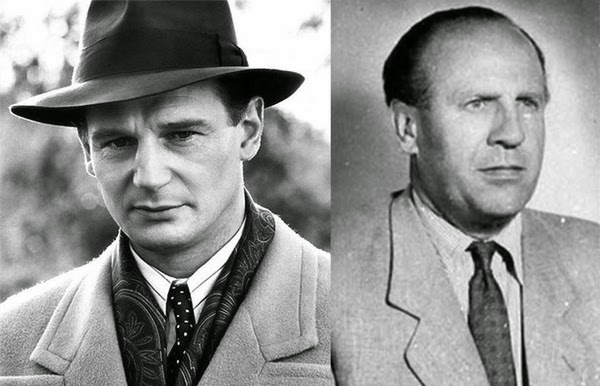
Oskar Schindler


Many of us have seen or heard of the movie Schindler's List which was based on the book Schindler's Ark written by Thomas Keneally who for those who don't know is an Australian author.

Anyway Oskar Schindler was a real person granted not a good looking as Liam Neeson played him in the movie but a real person none the less. There is a website about the man here:
http://www.oskarschindler.com/ However, I will tell you a little about the man here just because I can.

He was born in 1908 and grew up in Zwittau, Moravia wherever that is, I Goggled it and it is the Czech Republic. In 1936 he joined the Abwehr aka intelligence service of Nazi Germany and in 1939 he joined the Nazi Party. He was an industrialist a spy and in time a man who cared enough to save around 1,200 Jews during the Holocaust.

In 1938 he was arrested for espionage by the Czech government but was released under the terms of the Munich Agreement, although he continued to collect information for the Nazis in Poland in 1939.

It was in 1939 that he obtained an enamelware factory in Poland which employed around 1,750 workers about a thousand of those were Jews, his Abwehr connections helped him protect his Jewish workers from deportation and death in the Nazi concentration camps.

He started out wanting to make money this was his main goal but in later years he became more interested in shielding his workers without regard for the cost involved. As time went on he had to give Nazi officials larger and larger bribes and luxury gifts obtained on the black market to keep his workers safe.

His factories were located in occupied Poland and the Czech Republic by 1944 Germany was losing the war and the SS began closing down the easternmost concentration camps and evacuating the remaining prisoners westward. Schindler convinced SS-Hauptsturmfuhrer Amon Goth commandant of the nearby Krakow-Plaszow concentration camp, to allow him to move his factory to Brunnlitz, thus sparing his workers from certain death in the gas chambers.

Using names provided by Jewish Ghetto Police officer Marcel Goldberg, Göth's secretary Mietek Pemper compiled and typed the list of 1,200 Jews who travelled to Brünnlitz in October 1944. Schindler continued to bribe SS officials to prevent the execution of his workers until the end of World War II in Europe in May 1945, by which time he had spent his entire fortune on bribes and black-market purchases of supplies for his workers.

On 15 October 1944 a train carrying 700 men on Schindler's list was initially sent to the concentration camp at Gross-Rosen, where the men spent about a week before being re-routed to the factory in Brünnlitz. Three hundred female Schindlerjuden were similarly sent to Auschwitz, where they were in imminent danger of being sent to the gas chambers. Schindler's usual connections and bribes failed to obtain their release. Finally after he sent his secretary, Hilde Albrecht, with bribes of black market goods, food and diamonds, the women were sent to Brünnlitz after several harrowing weeks in Auschwitz.

In addition to workers, Schindler moved 250 wagon loads of machinery and raw materials to the new factory. Few if any useful artillery shells were produced at the plant. When officials from the Armaments Ministry questioned the factory's low output, Schindler bought finished goods on the black market and resold them as his own. The rations provided by the SS were insufficient to meet the needs of the workers, so Schindler spent most of his time in Kraków, obtaining food, armaments, and other materials. His wife Emilie remained in Brünnlitz, surreptitiously obtaining additional rations and caring for the workers' health and other basic needs. Schindler also arranged for the transfer of as many as 3,000 Jewish women out of Auschwitz to small textiles plants in the Sudetenland in an effort to increase their chances of surviving the war.

In January 1945 a trainload of 250 Jews who had been rejected as workers at a mine in Goleschau in Poland arrived at Brünnlitz. The boxcars were frozen shut when they arrived, and Emilie Schindler waited while an engineer from the factory opened the cars using a soldering iron. Twelve people were dead in the cars, and the remainder were too ill and feeble to work. Emilie took the survivors into the factory and cared for them in a makeshift hospital until the end of the war. Schindler continued to bribe SS officials to prevent the slaughter of his workers as the Red Army approached On 7 May 1945 he and his workers gathered on the factory floor to listen to British Prime Minister, announce on the radio Germany's surrender.

Schindler moved to West Germany after the war, where he was supported by assistance payments from Jewish relief organisations. After receiving a partial reimbursement for his wartime expenses, he moved with his wife to Argentina, where they took up farming. When he went bankrupt in 1958, Schindler left his wife and returned to Germany, where he failed at several business ventures and relied on financial support from Schindlerjuden ("Schindler Jews") – the people whose lives he had saved during the war. He was named Righteous Among the Nations by the Israeli government in 1963.

He died on 4 October 1974 in Hildesheim, Germany, and was buried in Jerusalem on Mount Zion, the only member of the Nazi party to be honoured in this way.


Week 38 of 2026

  After a good night I was awake and up at 4.30am, I got straight into housework, cleaning the kitchen, unpacking the dishwasher, sweeping a...